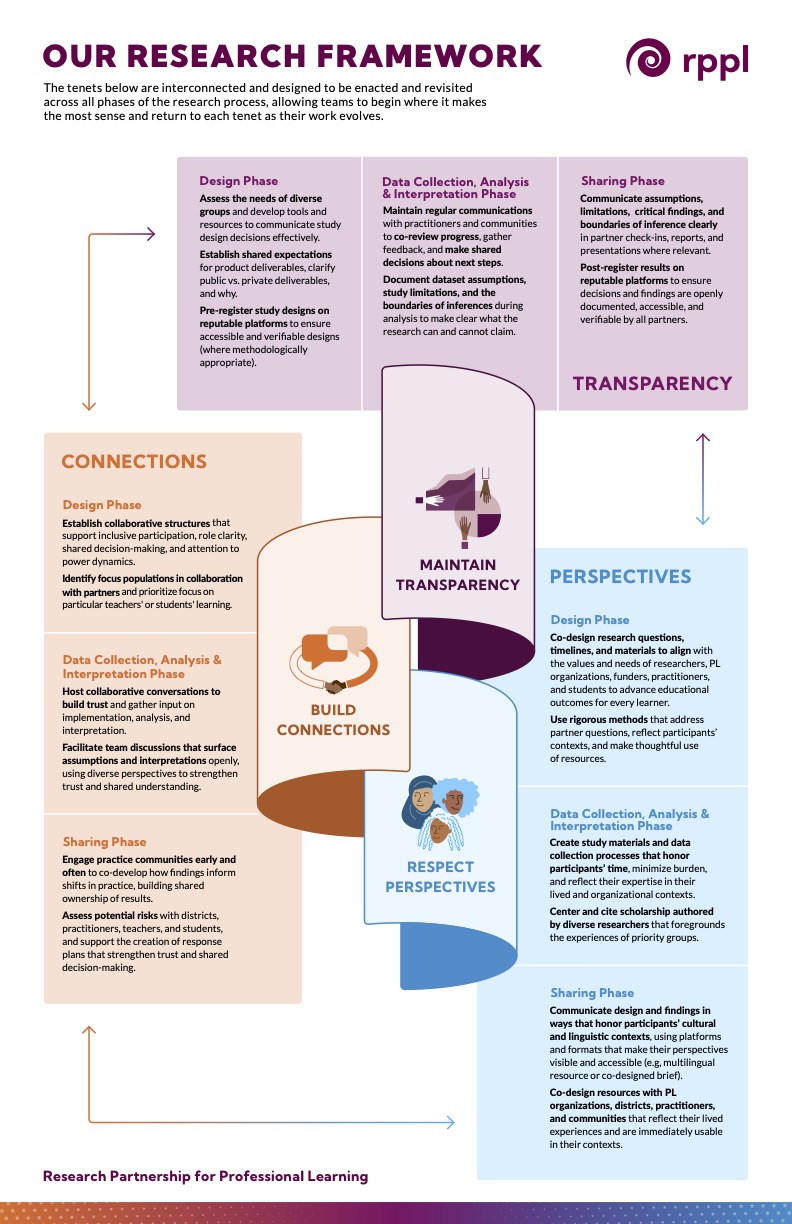
Our Research Framework was created by a synthesis of national research frameworks, peer-reviewed scholarship, and established best practices for conducting research in partnership.
At RPPL, rigor is defined by the combination of study design and study methodology, rather than by design type alone. We define rigor as using research methods that are well-suited to the research questions of interest and carrying out those methods in line with best practices in the field.
Our Research Framework helps research teams and partners work together to make PL research more relevant, collaborative, and impactful. By guiding shared decisions across design, implementation, and use, it leads to findings that are practical, credible, and better positioned to improve learning for students.
“I love that the Research Framework lays out inclusive practices at different phases of the work. It’s something we can reference to guide our work and make sure we’re thoughtful about including partner voices at every step.”
References List:
- Castillo, W. & Gillborn, D. (2023). How to “QuantCrit:” Practices and Questions for Education Data Researchers and Users. (EdWorkingPaper:22-546). Retrieved from Annenberg Institute at Brown University: https://doi.org/10.26300/v5kh-dd65
- Diamond, J. (2021, July 19). Racial equity and research practice partnerships 2.0: A critical reflection. WT Grant Foundation. https://wtgrantfoundation.org/racial-equity-and-research-practice-partnerships-2-0-a-critical-reflection
- Farrell, C.C., Penuel, W.R., Coburn, C., Daniel, J., & Steup, L. (2021). Research-practice partnerships in education: The state of the field. William T. Grant Foundation.
- Henrick, E. C., Cobb, P., Penuel, W. R., Jackson, K., & Clark, T. (2017). Assessing Research-Practice Partnerships: Five Dimensions of Effectiveness. William T. Grant Foundation. Retrieved from https://rpp.wtgrantfoundation.org/library/uploads/2017/10/Assessing-Research-Practice-Partnerships-Five-Dimensions-of-Effectiveness.pdf
- Hill, H., Papay, J., Schwartz, N., Johnson, S., Freitag, E., Donohue, K., Berry, R., III, Loeb, S., Anderson, M., Baker, M., Cato Czupryk, B., Coddington, C., Ehlman, K., Maus, A., Meili, L., Paek, P., Romansky, C., Taylor-Perryman, R., Vu, H., Worthman, S., & Williamson-Zerwic, B. (2021).A learning agenda for improving teacher professional learning at scale. Research Partnership for Professional Learning.
- Krause, Heather & Richburg-Hayes, Lashawn. (2023). The Data Equity Framework: A Concrete and Systematic Equity-Oriented Approach to Quantitative Data Projects. 10.31235/osf.io/sqt4u.
- Mohammed, S. (2020). Just Research Principles. https://bit.ly/JustResearchPrinciples
- National Center for Education Research. (2023). Best practices and challenges for embedding equity in education research: Technical working group summary. U.S. Department of Education. https://ies.ed.gov/ies/2025/01/best-practices-and-challenges-embedding-equity-education-research
- Vetter, A., Faircloth, B. S., Hewitt, K. K., Gonzalez, L. M., He, Y., & Rock, M. L. (2022). Equity and Social Justice in Research Practice Partnerships in the United States. Review of Educational Research, 92(5), 829-866. https://doi.org/10.3102/00346543211070048 (Original work published 2022)
- U.S. Department of Education, Institute of Education Sciences. (n.d.). Standards for excellence in education research. Retrieved December 15, 2025, from https://ies.ed.gov/use-work/standards-excellence-education-research-seer